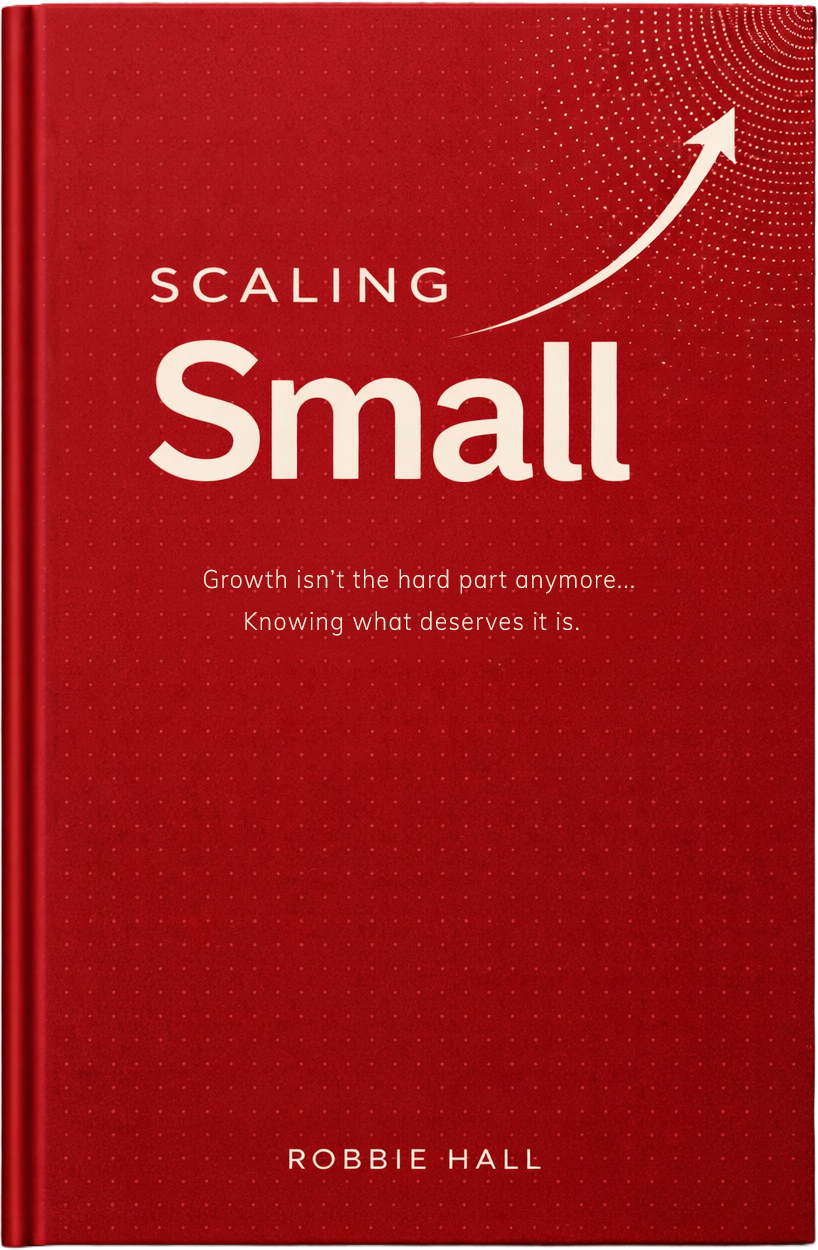
Growth isn’t the hard part anymore. Knowing what deserves it is.

A framework for faster iteration, clearer decisions, and scaling what actually works.

Get Early Access
Scaling Small book cover

This isn’t about doing less.

It’s about scaling what actually works.

The Real Shift

We used to scale with people. More roles, more layers, more coordination. Growth meant headcount.

Now we scale differently. AI has made it possible for a single person to do what used to take a team—to build, test, design, ship, and iterate without waiting.

The bottleneck isn’t resources anymore. It’s capability.

AI didn’t replace teams.
It raised the standard of the individual.

The new advantage isn’t access. It’s how well you use it.

The Real Problem

Growth isn’t harder than it used to be. It’s easier. That’s exactly why more things break.

When you can build anything quickly, you also risk scaling things that were never fully understood. Weak systems, unclear positioning, the wrong hires—everything expands just as fast as your wins.

The challenge is no longer getting momentum. It’s knowing what deserves it.

Scaling Small

Scaling Small starts with scaling yourself. Becoming faster at learning. Clearer in decisions. Stronger in execution.

Not doing everything alone—but becoming capable enough to know what matters, what works, and who to bring in next.

You don’t need a bigger team to start.
You need a more capable builder.

You don’t scale ideas.
You don’t scale effort.
You scale proof.

In the age of AI, the advantage belongs to the teams that can test quickly, learn honestly, and move with clarity on what actually works.

The Gap

There’s always a moment between signal and action. Between what the data is telling you and what you choose to do next.

Most people fill that space with activity. The best use it to refine what’s real, what’s noise, and what’s ready to scale.

That discipline compounds.

A Better Way to Build

The tighter your loop, the more powerful you become.

Test Learn Refine Scale

Test faster. Learn faster. Decide faster. Build proof in layers—each step earns the next, each decision strengthens the system.

That’s how individuals become leverage. And that’s how small becomes scale.

Principles

Feedback Loops

The speed of your learning determines the speed of your growth. Shorten the loop.

Precision Over Volume

More output doesn’t create advantage. Better decisions do.

Smart Scaling

Growth should follow proof, not pressure. Scale what has already held under real conditions.

Clarity Before Complexity

If it’s unclear at a small level, it will break at a large one.

People Over Process

Systems matter, but people determine outcomes. The right team multiplies what works.

Focus As Leverage

Trying to do everything at once slows everything down. Constraint creates momentum.

The Human Side

Technology accelerates everything. But people still determine outcomes.

You don’t scale by adding people too early. You scale by becoming someone worth scaling around.

Then you bring in others like you—people who can think, build, and own outcomes. Not just execute tasks, but extend what works.

As you grow, your business becomes a reflection of who you were willing to become first.

Small is how you build
something worth scaling.

Scaling Small is about becoming capable enough to build, test, and prove what works—before you ever try to scale it.

About

I’m Robbie Hall, founder of Colony.

I’ve built in environments where speed was expected and growth was constant. Some of that growth worked. Some of it didn’t. From the outside, they looked the same.

Scaling Small came from understanding why—and learning how to see the difference early, before growth turns into something you have to fix.

Scaling Small

If you’re building something right now— this is the moment that matters.

Before it scales. Before it hardens. Before it becomes harder to change.

One email when the book is ready. Nothing else.